Friday, 20 March 2015

Birding 'Up the Valley'

This morning we explored the Old Hidalgo Pumphouse - a World Birding Center very close to the Rio Grande River.
It was originally used to pump water from the Rio Grande for crop irrigation. Initially the boilers were fired with mesquite wood. then converted to oil, then natural gas, then diesel. There is an interpretive centre in the old pumphouse, however today, we just explored the natural surroundings.

One of the first things we heard, then saw was a flock of noisy monk parakeets. This is the best I could do for a photo of one of them.
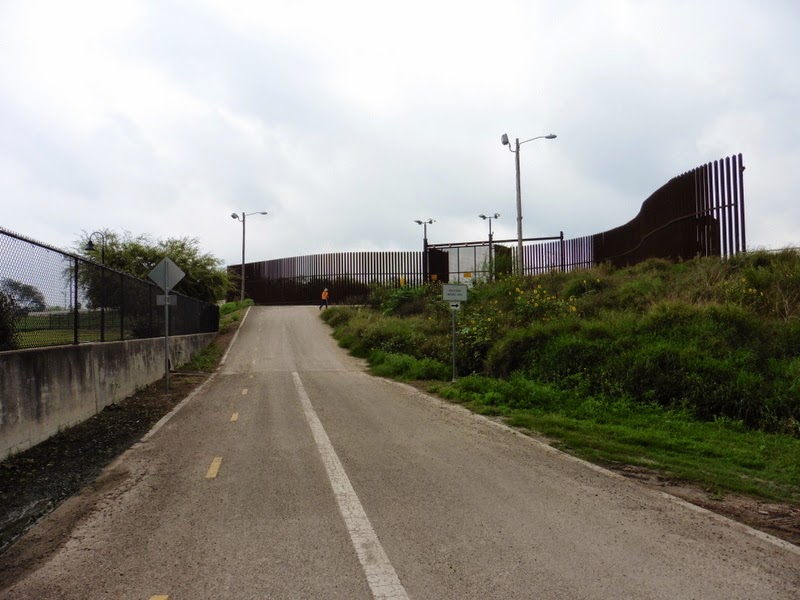
The border wall patrolled 24/7 runs through the area between the upper pumphouse area and the lower floodplain. This part is where the road goes over the levee.
Here's a panoramic shot.
and a shot of the covered area. I can imagine it is blisteringly hot here in the summer and the covering is a welcome respite.
Another view of the border wall from the path leading to the trail.
This is the old pumphouse.
This is a Couch's kingbird. I believe the difference between it and a tropical kingbird is the angle of the beak.
Another panoramic shot from the levee showing the border wall on the left (facing west) and the levee facing east on the right side.
We saw many kiskadees, a black phoebe, a scissor-tailed flycatcher, and many grackles.

After lunch, we then headed to Quinta Mazatlán - another World Birding Center and historical adobe mansion just east of the McAllen, TX airport.
It was built by in the 1930s by composer, writer and adventurer, Jason Matthews and his wife, Marcia, with 10,000 adobe bricks that were made on site. The owners lived there until the 1960s. It was then for sale from 1964 - 1967. Hurricane Beulah destroyed a lot of the roof. It was then purchased for $24,000 by Frank and Marilyn Schultz. Restoration began adding stone patios and expanding the home. Exotic flowers, shrubs, and trees were planted as well as welcoming the regrowth of the native Thornforest. The Schultz family lived and raised their children there for 30 years. In 1998 the estate was put up for auction after Mrs. Schultz' death. The city of McAllen purchased it and the surrounding eight acres for $1.4 million. Mr. Schultz died unexpectedly in 2009.
Quinta Mazatlan is now the McAllen wing of the World Birding Center.
There are over 100 species of birds and over 100 species of tropical and native trees, flowers and plants identified there. 

We spotted many chachalacas (I included this imperfect photo as it is the only one that shows the patch of red on its throat)


inca doves (a small dove with defined feathers),


white-winged doves,
a cute, but mangy-looking squirrel,
many kiskadees, house sparrows, and a clay-coloured robin - a life bird for both Skip and me.

It was warm and humid - like it should be this time of year. Ahhhh.

Thursday, 19 March 2015

Birding Group

It was very foggy this morning with only 1/4 mile of visibility.
Hilton Garden Inn in the fog as seen from the boardwalk of the World Birding Centre on SPI
Crossing the Queen Isabella causeway from the island to Port Isabel we were engulfed in fog on the highest part of the span. Once we started our birding, things started to clear up and by the time we got to Palo Alto we saw mostly blue sky. The temperature got up to 26C - ahhhhh. It will be like that again tomorrow and again on Sunday after rain on Saturday.

There is a birding group that meets every Thursday morning at the South Padre Island Golf Course in Laguna Vista. We finally made it to one of the meetings today. Last week we slept in and the week before it was raining.

We decided to birdwatch along Highway 100 and then go down from Los Fresnos to the Palo Alto Historical Battle Site.

The first significant one we saw was a peregrine falcon. It was very far away so this is my camera zoomed 90x. I finally learned how to use the digital zoom on the damned thing. The pictures are quite grainy at that distance but there is enough detail to accurately identify it.
Then we saw this Harris hawk on a wire along the road.
It even let me drive abreast of it so I could get a good photo.
As there has been so much rain this winter, a lot of the terrain is flooded. It isn't unusual to find kingfishers at the side of the road hoping to fish in flooded fields and ditches. This is a belted kingfisher.
A couple of the people in the group we were with do some fundraising for birding interests in the area. This aplomado falcon box was erected as a result of some of that fundraising.
I took these shots through our spotting scope. This is another life bird for me. The aplomado falcon is an endangered non-migratory, medium sized falcon. There were as few as 2 pairs of them in the 1940s and 50s due to the hobby of egg collection that used to be popular. It was put on the endangered list in the 1980s.
We saw many meadowlarks today. There is always a debate as to whether it is eastern or western. Apparently one makes the distinction by the call.
We heard and saw several of them today.
Most big, black birds we see here are grackles. Today we saw these 'chunky' black birds - Chihuahuan ravens. This is another life bird for me. In fact we saw 5 of them today. Apparently their skin is white, so if you see a parting of the feathers, you will see white. Here you can see it on the neck of the one on the left.
Pulling into the Palo Alto parking lot, we heard, then saw this curve-billed thrasher, belting it out at the top of a tree.
Walking along the path we saw, then heard this flock of sandhill cranes flying overhead.
Other birds we spotted were: a scissor-tailed flycatcher, a loggerhead shrike, a crested caracara, a verdin (life bird), a Cassin's sparrow (another life bird ), etc. We also saw a herd of about 6 nilgai - the largest type of Asian antelope. According to Wikipedia, 'Nilgai were introduced in the US state of Texas in the 1920s by the King Ranch for recreational purposes [hunting]. Over the years, some escaped and they are not free-ranging in various southern portions of the state.' There are about 30,000 of them in the Texas/Mexico are - 10,000 of them on the King Ranch. 

Skip and I are taking a mini-holiday from Spring Break on the island and are spending the next three days 'up the valley' in and around McAllen, TX. We plan to visit the remaining three World Birding Centers - Quinta Mazatlan, the Old Hidalgo Pumphouse, and the Roma Bluffs. We're also close to Bentsen State Park so may stop in there as well. Saturday will be rainy so we'll probably shop then and do other indoor pursuits.

After lunch in Los Fresnos with our new birding friends, Skip and I bid farewell and made our way to the Rio Grande Valley Livestock Show. It was only $10 to get in. There were lots of animals being shown or getting ready to be shown. We also saw a little kids' tractor pull.
This little girl had a full pull of 10' with a 250 lb. load.
The parking lot was a mass of mud. I have a lot of scraping to do to get the mud off my shoes.

Another area we explored was the antique farm machinery building. At the far end was a couple of old timers operating a rope making machine.

I got to give it a whirl and made a length of rope. Basically it was like a three-clip fringe twister with strands of nylon rope twisted as three individual pairs, then the three plied strands were twisted together. I got to add a piece of blue acrylic yarn to two of the pairs of strands.
By 3pm we had had a full day, having risen at 6am to get to meet up with the birding group by 8am. Once we got checked into our hotel, I passed out for a couple of hours. I feel much better now and look forward to more adventures tomorrow.

As I clicked the button to publish this post, I noted that it is my 1000th post since beginning blogging in May of 2007. I really enjoy reading about some of the things we've done these past 7+ years and looking at the photos. This blog has very much been a pictorial journal for me and it's been very nice to have acquired some followers as well as knowing there are others 'out there' reading it as well. Happy 1000th Postiversary to me!

Wednesday, 18 March 2015

Better Weather

The last couple of days we've had better weather for at least part of the day.

On Monday, we went to the birding centre on the island later in the afternoon.

There was something not quite right about this great egret. On closer inspection we, and another birder who came along, determined that it was indeed a reddish egret in white morph phase. The posture and black-tipped, pink beak gave it away.
We were lucky enough to get a good look at the green heron again.
This red-eared slider turtle looked so relaxed sprawled out on the reeds.
We retraced our steps on the boardwalk. It often gives us a different perspective. Sure enough, we turned a corner and found this black-crowned night heron not too far from the boardwalk.
Here, the two stiff, long plumes out of the back crown of its head can be seen clearly.
It wasn't really a cold day but when the sun goes behind the clouds and we're so close to the laguna, it can feel pretty 'fresh'.
One of the birders was sure this was a yellow rail because the tail feathers weren't flipped up like a sora usually does. However, there are several differences between this sora and a yellow rail.
Then we came upon this great blue heron catching a large fish.
It was giving the heron a bit of a struggle.
He could barely carry it and appeared to be taking it over to dry land. We hung around hoping to see how he would eat it but he let it go after all. I think it was just too big.
Back at one of the water features at the birding centre, I got a good shot of this mottled duck and it's beautiful blue feather just under its wing.
There were lots of these 4-leafed plants floating in the water.
Back in the parking lot, I took a couple of shots of flowers from the sea grape tree.
This colour appeared on the same branch as the one above but there didn't appear to be a graft. I think the yellow flower turns to this coral colour.
I'm trying to drink in all the sights of this lovely place as it will be at least 10 months before we visit here again, if not longer. I'm taking a lot of photos of flowers to put on my desktop slide show to tide me over.
Lantana
Yesterday morning we went for breakfast off the island in Port Isabel. On the way back to the condo we stopped at the Sheepshead Woodlot Sanctuary , where six wooded residential lots - three on the north side of the street and three on the south side - are situated as a welcome place for migrating birds to rest after flying across hundreds of miles across the Gulf of Mexico.

When we first arrived, we quickly spotted a black and white warbler, a white-eyed vireo and several northern parulas - a life bird for me. These guys flit around so much it was hard to get a good shot in the partial shade with my point and shoot camera but you get the idea.
Northern Parula
I also saw a ruby-throated hummingbird sipping at flowers rather than at a feeder.

A fellow birder from Colorado who pulled up when we were there spotted a water thrush at the water feature on the south side of the street. It was too muddy for me to venture across to it so I didn't get a chance to see it. We'll stop by there today to have another look on our way by.