I knit a brioche cable hat. It was inspired by the Marilynn Blacketer "Brioche Cable Cap". Instead of doing a column of cables up one side of the hat, I decided to do cables all around the bottom to serve as a cuff. The cables pull the fabric in somewhat which would help keep it on one's head.
I cast on 84 sts which is a multiple of 12 = 4 sts between cables + 8 sts (4 x 4 cable).
Brioche is reversible so this is what the inside looks like.
I used an entire ball of the eggplant (darker CC) yarn and almost the full skein of the green yarn. As there wasn't enough of either to make a decent-sized pompom, Alexa said a faux fur pompom would work. I remembered I had 3 of them in my stash so thought I'd audition each one. Above is the black one. Here's a white one:
And a grey one.
I like the look of the black one best.
I still have a couple of balls of each colour of yarn so plan to make a cowl to match.
Wednesday, 21 August 2019
Friday, 16 August 2019
Backyard Bonanza
There was lots of activity in the backyard yesterday. I spotted two, young, female Baltimore orioles but didn't get pics of them. I had seen them a couple of days ago so wonder if they've taken up residency somewhere nearby.
I did release the 19th adult monarch. I saw monarchs flitting around the garden and later in the afternoon I spotted one feeding on one of Skip's giant zinnias. If you look closely, you can see the unfurled proboscis (tongue-like structure).
The spot along a vein in the hind wing indicates that it is a male. On the fore wing on the same side, there is a chunk out of the edge of the wing and the colours are a bit faded. This adult has been around for a while. He could be nectaring to get the strength to make the migration to Mexico.
He spent quite a bit of time on the giant Joe Pye Weed blooms.
Then a female ruby-throated hummingbird flew in.
She actually rested to feed on one of the zinnias.
She fed on several of them. I liked this action shot.
Here's a totally amateur, unedited video of the event. Click on triangle to play then the little box (bottom right) to view full screen.
I did release the 19th adult monarch. I saw monarchs flitting around the garden and later in the afternoon I spotted one feeding on one of Skip's giant zinnias. If you look closely, you can see the unfurled proboscis (tongue-like structure).
The spot along a vein in the hind wing indicates that it is a male. On the fore wing on the same side, there is a chunk out of the edge of the wing and the colours are a bit faded. This adult has been around for a while. He could be nectaring to get the strength to make the migration to Mexico.
He spent quite a bit of time on the giant Joe Pye Weed blooms.
Then a female ruby-throated hummingbird flew in.
She actually rested to feed on one of the zinnias.
She fed on several of them. I liked this action shot.
Here's a totally amateur, unedited video of the event. Click on triangle to play then the little box (bottom right) to view full screen.
Tuesday, 13 August 2019
Visitors to the Monarch Farm
There has been a lot of action at Casa Monarca these past two days. 4 adults eclosed yesterday and 3 more today. There was also one in a 'j' formation which pupated a few minutes later. It was #26.
I had kept captive the four that eclosed yesterday as I was expecting young visitors to the 'farm' today and wanted to make sure I had adults to release while they were here. I didn't need to worry as three more eclosed this morning. When I unzipped the 'castle' this guy was ready to taste freedom.
Shortly thereafter he flew over to the cedars along the side fence of our yard. Here, he unfurled his proboscis (tongue), in preparation for feeding.
When one has a monarch farm there is always something interesting going on. I'm glad Alice and Oliver could see my operation. It was pretty fun having young ones around.
I had kept captive the four that eclosed yesterday as I was expecting young visitors to the 'farm' today and wanted to make sure I had adults to release while they were here. I didn't need to worry as three more eclosed this morning. When I unzipped the 'castle' this guy was ready to taste freedom.
Shortly thereafter he flew over to the cedars along the side fence of our yard. Here, he unfurled his proboscis (tongue), in preparation for feeding.
My friend, Alexa, came over with two of her grandchildren to check out my operation. Oliver and Alice helped me find monarch eggs and larvae out in the garden.
Then they did some relevant colouring.
I sent them home with more activities which could be done back at Grandma's where they are visiting for the rest of the week.When one has a monarch farm there is always something interesting going on. I'm glad Alice and Oliver could see my operation. It was pretty fun having young ones around.
Monday, 12 August 2019
Spring Ice Mittens
I finished another pair of trigger mittens, Spring Ice mittens from the 'Saltwater Mittens' book.
I did go up a needle size to provide ample room and added extra stitches for the index fingers and thumbs.
They look complicated but really did knit up quickly. I have to show them off for Show and Tell tomorrow night at my spinning/knitting/crochet group and on Thursday to my stitching group then they're going in the mail to my friend, Cathy.
I'm using a very sturdy acrylic yarn - Loops & Threads Impeccable Solids from Michaels. They are made for working on the farm.
As per the pattern, I continued the pattern up the index (trigger) finger and knit salt and pepper stitches for the rest of the fingers, thumb, and palm.I did go up a needle size to provide ample room and added extra stitches for the index fingers and thumbs.
They look complicated but really did knit up quickly. I have to show them off for Show and Tell tomorrow night at my spinning/knitting/crochet group and on Thursday to my stitching group then they're going in the mail to my friend, Cathy.
Saturday, 3 August 2019
Blowin' A Gale
The other day I finished the second trigger mitten for my friend, Cathy.
Here's the back of the first one. I continued the pattern all the way to the tips of the fingers.
The 'salt and pepper' pattern is very common with these folksy Canadian mittens.
Here is the pair of them. I did end up making the first mitten a little longer as my fingers just touched the top and Cathy's hands are longer than mine.
These mittens are really for warmth. The alpaca yarn is lovely but won't stand up to hard wear so I'm going to knit her a second pair with more durable yarn. Poor dear is allergic to wool (alpaca's fine, though) so the next pair will be acrylic and high contrasting yarns - blue and while.
I've been stitching away on the model sampler I'm knitting for Teresa Kogut. I have most of the picture done and have started the alphabet. Photos won't be revealed until she releases the pattern or gives me permission to show it.
Here's the back of the first one. I continued the pattern all the way to the tips of the fingers.
The 'salt and pepper' pattern is very common with these folksy Canadian mittens.
Here is the pair of them. I did end up making the first mitten a little longer as my fingers just touched the top and Cathy's hands are longer than mine.
These mittens are really for warmth. The alpaca yarn is lovely but won't stand up to hard wear so I'm going to knit her a second pair with more durable yarn. Poor dear is allergic to wool (alpaca's fine, though) so the next pair will be acrylic and high contrasting yarns - blue and while.
I've been stitching away on the model sampler I'm knitting for Teresa Kogut. I have most of the picture done and have started the alphabet. Photos won't be revealed until she releases the pattern or gives me permission to show it.
Purple Coneflower Feeding Frenzy
I was out in the garden a while ago looking for some tasty milkweed for my larvae and found several butterflies and bees feeding on the purple coneflowers.
I always have to look up the differences between Red Admiral butterflies and Painted Lady butterflies. They look quite similar when the wings are closed.
This one's a Red Admiral.
I never did get a good shot of a Painted Lady with its wings open but here's one from the Internet.
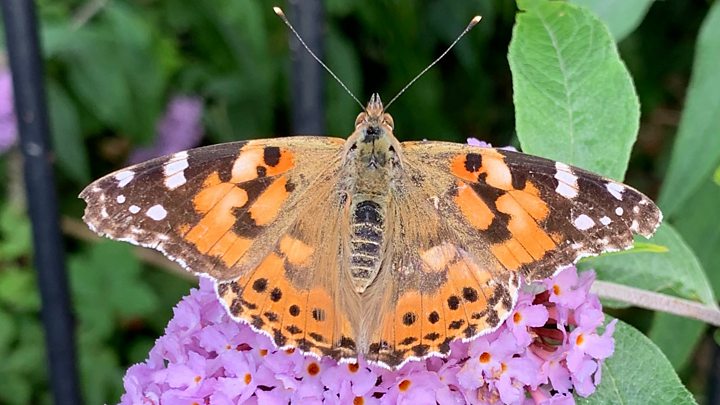
They're very photogenic - as are most things in nature, I guess. I like the striped antennae and the furry body. Here you can see the black 'tongue' sipping from the flower.
I found this on the underside of a milkweed leaf. I captured it in a jar only to realize it was dead. I have no idea what it was - probably some type of beetle.
I'm not sure what this insect is either. I'm hoping it's a good one - one that pollenates.
There are all kinds of bees on the plants. This little one was very busy. Its legs are thickly covered with pollen.
In monarch news, I have 14 pupae. The next one should eclose next week. There are 2 in 'j' formation. I also have about a dozen larvae in various stages of development and a few eggs.
I'm getting to the point where I have to drive around and take milkweed from 'naturalized' areas (neglected lots, construction sites, unmowed area of parks) to bring home for my larvae. However, the green water reservoirs are doing a great job at keeping many of the stems and leaves fresh.
I always have to look up the differences between Red Admiral butterflies and Painted Lady butterflies. They look quite similar when the wings are closed.
This one's a Red Admiral.
Red Admiral with closed wings.
Painted Lady with closed wings. I now see that the Painted Lady has a row of 'eyes' on the hind wing near the edge. The Red Admiral has the lighter coloured edge to the hind wing.I never did get a good shot of a Painted Lady with its wings open but here's one from the Internet.

They're very photogenic - as are most things in nature, I guess. I like the striped antennae and the furry body. Here you can see the black 'tongue' sipping from the flower.
I found this on the underside of a milkweed leaf. I captured it in a jar only to realize it was dead. I have no idea what it was - probably some type of beetle.
I'm not sure what this insect is either. I'm hoping it's a good one - one that pollenates.
There are all kinds of bees on the plants. This little one was very busy. Its legs are thickly covered with pollen.
In monarch news, I have 14 pupae. The next one should eclose next week. There are 2 in 'j' formation. I also have about a dozen larvae in various stages of development and a few eggs.
I'm getting to the point where I have to drive around and take milkweed from 'naturalized' areas (neglected lots, construction sites, unmowed area of parks) to bring home for my larvae. However, the green water reservoirs are doing a great job at keeping many of the stems and leaves fresh.
Tuesday, 30 July 2019
Finding Lots of Larvae
Skip and I were at the waterfront the other evening and I spotted 2 rather large larvae on a milkweed plant. I plucked off their respective leaves and brought them home. They've both either pupated or are in the process of pupating.
To date I've released 3 male adults and have 6 pupae (chrysalises) and 2 hanging in a 'j' getting ready to pupate. I have 8 - 10 larvae in various stages of development and several eggs.
These two will be getting ready to pupate any day now. I have them in a plastic bin covered with mesh. Yesterday I transferred 3 pupae from the mesh above this bin to the top of the Caterpillar Castle by carefully pulling the silken threads away from the mesh and literally stitching each one to the top of the 'castle'. I had to make sure the chrysalises were hard before doing this so as not to harm them.
In the 'castle; the one in the back right is getting ready to pupate. The ones in the front continue to munch and poop away.
Two pupae can be seen behind this 'j' hanger.
In the top centre, another one is hanging in a 'j', getting ready to pupate.
There's a lot of activity in a very small space in my kitchen. I keep finding eggs every time I go out to find fresh leaves for the larvae. I'm going to have to start cruising the area for fresh milkweed before too long as very soon I'll have many more larvae to feed and once they get bigger, they each consume about one leaf per day.
To date I've released 3 male adults and have 6 pupae (chrysalises) and 2 hanging in a 'j' getting ready to pupate. I have 8 - 10 larvae in various stages of development and several eggs.
These two will be getting ready to pupate any day now. I have them in a plastic bin covered with mesh. Yesterday I transferred 3 pupae from the mesh above this bin to the top of the Caterpillar Castle by carefully pulling the silken threads away from the mesh and literally stitching each one to the top of the 'castle'. I had to make sure the chrysalises were hard before doing this so as not to harm them.
In the 'castle; the one in the back right is getting ready to pupate. The ones in the front continue to munch and poop away.
Two pupae can be seen behind this 'j' hanger.
In the top centre, another one is hanging in a 'j', getting ready to pupate.
There's a lot of activity in a very small space in my kitchen. I keep finding eggs every time I go out to find fresh leaves for the larvae. I'm going to have to start cruising the area for fresh milkweed before too long as very soon I'll have many more larvae to feed and once they get bigger, they each consume about one leaf per day.
Subscribe to:
Posts (Atom)


